What Happens Inside a Mattress When Two Sleepers Have Very Different Body Weights


When two people share a mattress but have very different body weights, the surface may look unchanged, but the interior tells a much more complex story. Mattresses are mechanical systems designed to manage load, resist deformation and recover night after night. When weight is uneven, the way materials compress and respond becomes critical.
Load Distribution Across the Sleep Surface
Every mattress distributes weight through a combination of surface materials and core support. When two sleepers have similar body weights, compression tends to be relatively uniform. When the weight difference is significant, load distribution becomes asymmetric.
The heavier sleeper applies greater downward force, compressing comfort layers more deeply and engaging the support core earlier. The lighter sleeper may barely activate the deeper support layers at all. If the mattress is not designed to manage these differences, one side can sink while the other remains relatively flat.
Effective mattress support for couples depends on how evenly the mattress can distribute unequal loads without allowing one sleeper’s weight to influence the other side.
Asymmetric Compression and Material Fatigue
Asymmetric compression occurs when one side of the mattress experiences significantly more stress than the other. Over time, this uneven loading can lead to differential wear. Foams may soften faster on the heavier side, coils may lose tension unevenly and the mattress can develop a visible slope toward one sleeper.
Low-density foams are especially vulnerable to asymmetric compression. They compress easily but recover poorly under repeated heavy loads. Once fatigued, they remain partially compressed, reducing support and increasing motion transfer.
Mattresses that rely on higher-density materials and resilient support cores are better equipped to handle long-term asymmetric stress.
Coil Response Under Uneven Weight
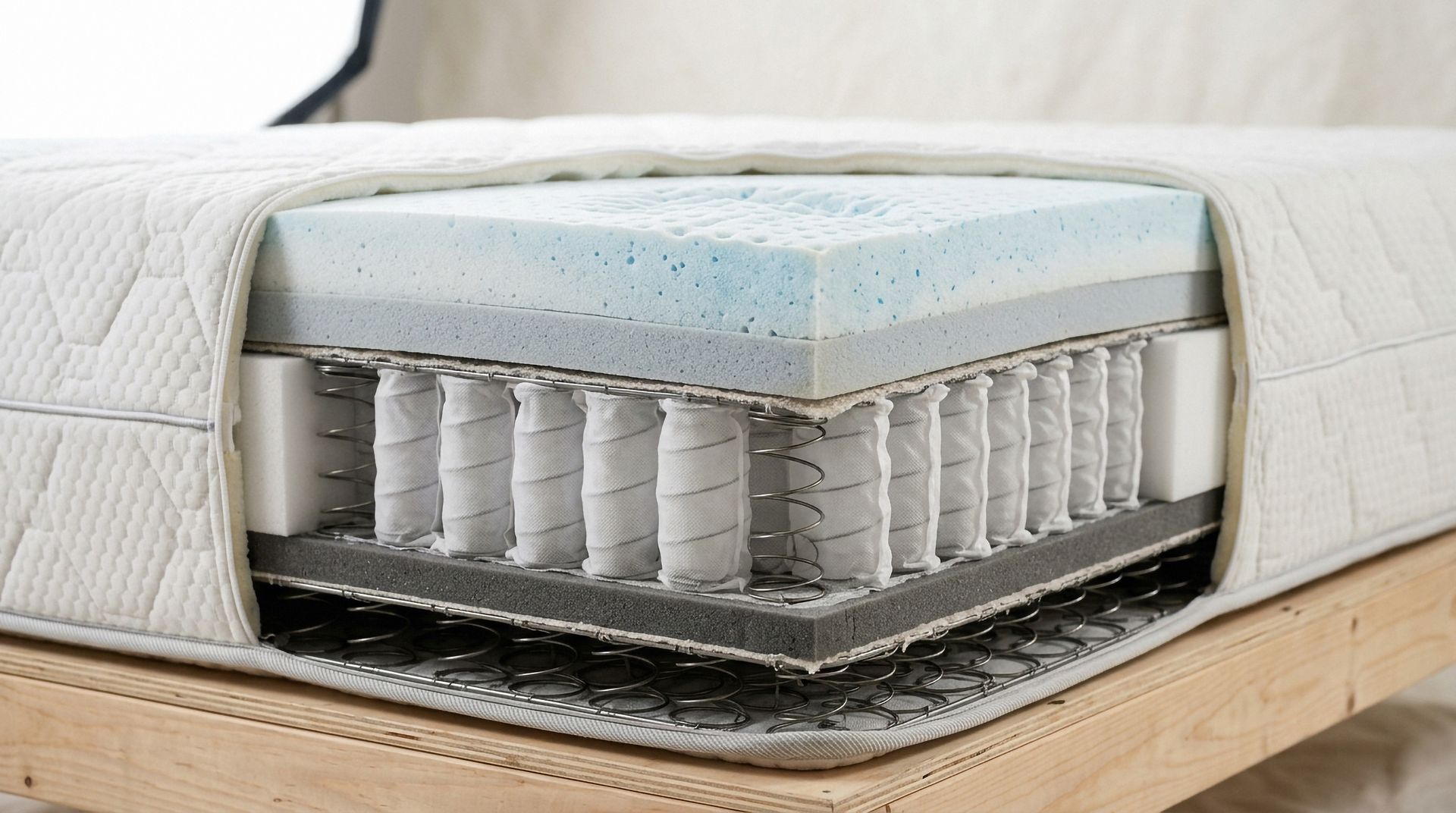
In innerspring and hybrid mattresses, coils play a central role in managing uneven body weights. Each coil is designed to compress independently, but the quality of that response depends on coil gauge, coil count and zoning.
Heavier sleepers compress coils more deeply, pushing them closer to their compression limit. If coils are too thin or poorly tempered, they lose resilience over time. Zoned coil systems address this by using firmer coils in high-load areas and more responsive coils elsewhere.
Zoned coil systems help maintain spinal alignment for both sleepers by preventing excessive sink on the heavier side while still allowing appropriate compression for the lighter sleeper.
The Role of Latex in Motion Isolation and Recovery
Latex behaves differently from conventional foams under uneven loads. A motion-isolation latex mattress responds proportionally to weight while remaining highly elastic. This means latex compresses where weight is applied but does not collapse laterally into surrounding areas.
For couples with different body weights, this material response matters. The heavier sleeper compresses their side of the mattress without pulling the surface toward them. The lighter sleeper experiences consistent support without being affected by the deeper compression nearby.
Latex also recovers quickly, reducing long-term material fatigue and helping the mattress maintain a level sleep surface over many years.
Lateral Load Transfer and Motion Control
When one sleeper moves, shifts position or gets out of bed, the mattress must absorb and contain that movement. Uneven weight increases the risk of lateral load transfer, where force travels across the mattress instead of staying localized.
Poorly constructed mattresses allow this force to propagate, causing the lighter sleeper to feel movement from the heavier sleeper more intensely. Materials like latex and individually wrapped coils reduce lateral force transmission by isolating compression to the point of impact.
Why Uniform Firmness Often Fails Mixed-Weight Sleepers
Many mattresses are built with uniform firmness across the entire surface. While this simplifies manufacturing, it often fails when sleepers have different body weights. Uniform firmness assumes uniform load, which rarely exists.
Without zoned construction, denser materials or responsive components, the mattress cannot adapt to asymmetric pressure.
Over time, this leads to premature wear, uneven support and compromised performance.
Long-Term Structural Stability Matters
The internal mechanics of a mattress determine how it ages. A mattress that can’t properly manage uneven loads will suffer accelerated structural degradation. This can result in sagging, reduced edge support and loss of alignment.
Durable mattresses use resilient materials, reinforced coil systems and construction techniques that resist uneven stress.
These features are not visible on the showroom floor, but they determine whether a mattress performs consistently over years of use.
Choosing a Mattress That Handles Unequal Weight
At Twilight Bedding, mattresses are engineered with these internal dynamics in mind. By combining responsive latex, durable support systems and thoughtful construction, Twilight Bedding offers solutions designed to manage uneven loads without sacrificing stability or longevity.
Visit one of our local showrooms to try mattresses built to handle real-world weight differences. Call our North Spokane location at (509) 413-2431 or our Spokane Valley location at (509) 926-2333 for more information.