
Can You Tell Mattress Quality Without Cutting It Open?

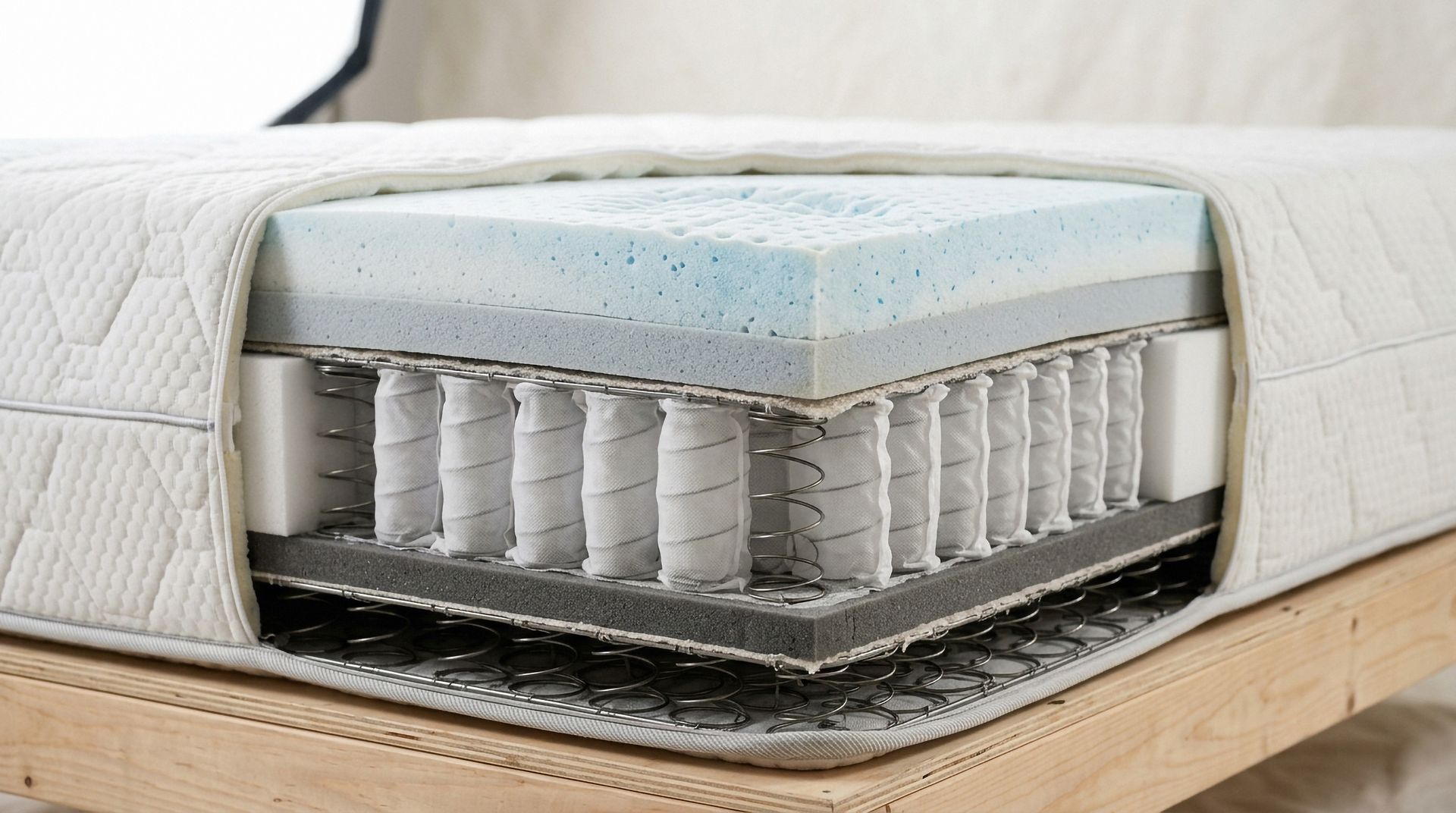
Buying a mattress can feel a little like buying a car without being allowed to look under the hood. You can see the fabric, lie on the surface and read the marketing claims, but much of what determines a mattress's long-term performance is hidden inside.
But you don't need to see inside the mattress to learn more about its construction, materials or likely performance.
Manufacturers should be transparent about what goes into their mattresses and how those components are intended to work, but shoppers can also learn a lot by paying attention to how a mattress looks, feels, responds to pressure and behaves when they move around on it.
Start With the Edge
Sit on the side and pay attention to how dramatically the mattress compresses. A little give is normal, particularly with softer mattresses, but an edge that collapses substantially under your weight may indicate limited perimeter reinforcement.
Edge support isn't only about sitting down to put on your shoes. Stronger edges can make it easier to get in and out of bed and provide a more stable sleeping surface near the perimeter.
Walk your hand along the edge, too. Does it feel consistently supported from corner to corner, or does the construction seem noticeably different in certain areas?
Don't Assume Heavy Automatically Means Better
A mattress may be heavy because it contains substantial coils, dense foam, latex or other materials. Latex, for example, tends to be relatively heavy, while different foam densities can contribute significantly to a mattress's overall weight.
However, simply comparing two mattresses by lifting them isn't enough. For example, a thick memory foam mattress may feel substantial, but that weight alone does not tell you whether the foam will maintain its shape or provide consistent support over time.
A somewhat lighter innerspring mattress could use durable steel coils, resilient comfort materials and a well-designed support system that ultimately performs better for longer.
Read the Specifications Like a Detective
A well-described mattress should give you useful information about its construction, including the types of comfort materials, transition layers and support system. Common mattress designs may contain a comfort layer, transition layer, support core and cover, with materials such as foam, latex or coils serving different purposes.
For foam mattresses, look for information about foam type and density. Density can provide useful information about potential durability.
For innerspring or hybrid mattresses, investigate the coil system. Are the coils individually wrapped? How many are used? What type of support does the perimeter have?
The more specific the manufacturer is, the easier it is for you to understand what you're paying for.
Look Closely at the Stitching and Tufting
Examine the seams, quilting, handles, corners and stitching. Are the seams straight and secure? Does the fabric look evenly tensioned? Is the quilting consistent across the surface?
Tufting and quilting aren't necessarily indicators of quality by themselves, but they can reveal how carefully a mattress has been assembled. Uneven stitching, loose threads, sloppy corners or inconsistent finishing should at least prompt additional questions.
Move Your Weight Around
Lie in your normal sleeping position, then slowly move toward the center, side and opposite side of the mattress. Pay attention to how the surface responds.
Does the mattress gradually contour around you? Does it spring back quickly? Does it feel like you're sinking into one area without much support underneath?
You can also sit in different locations and change positions. A mattress's response to movement can reveal differences in responsiveness, pressure relief and support that aren't obvious when you simply lie still for 30 seconds.
For couples, pay attention to what happens when one person moves while the other remains still. Motion isolation and responsiveness are both important aspects of how a mattress performs in real life.
Investigate What's Not Being Said
If a manufacturer provides detailed information about materials, layer thicknesses, construction methods and support systems, you have something concrete to evaluate.
If the description relies almost entirely on vague terms like "advanced technology," "premium materials" and "luxury feel", without explaining what those terms mean, you have less information with which to judge the mattress.
This doesn't automatically make a mattress bad. It simply means you should ask more questions before purchasing.
Treat the Warranty as Evidence, Not a Guarantee
A mattress warranty can tell you something about how a manufacturer stands behind its product, but don't confuse a long warranty with proof of superior quality.
Coverage usually applies only to specific defects, such as broken components, defective seams or permanent sagging that exceeds a stated depth. Gradual softening, shallow body impressions and ordinary wear may not qualify at all.
Also look at the fine print surrounding foundations, care requirements and the definition of a covered defect.
A 20-year warranty sounds impressive, but what matters is what happens when you actually need to use it.
The Best Test Is Still the Real-World Experience
Visit Twilight Bedding or contact us at (509) 413-2431 for our North Spokane location or (509) 926-2333 for our Spokane location to explore handcrafted mattress options and find a construction that fits the way you sleep.